
.png)


Always think about thinking ©
.png)
Piar is the thinking partner that global Chief Communications Officers (CCOs) are already looking for. CCOs with a growth-mindset, smart enough to know the power of having the right outside perspective.
Within the management function of the business, CCOs are the closest linked to being responsible for understanding the impact of changes in the outside environment, and help the company stay in touch. They're expected to be strategic advisors who can anticipate outcomes, weigh evidence, challenge leadership, and defend their thinking under pressure. But most were trained in communications, not strategic analysis.
Piar provides the thinking partner and decision frameworks that fill that gap—helping you arrive at either a defensive or attacking recommendation with logic that survives scrutiny.
We don't tell you what to do. We help you think through what you haven't solved yet.
Correlation ≠ causation. The external forces, headwinds, and tailwinds which have profound effects on the business can and should be measured. Piar's systems of lenses, frameworks, tools & methodologies make this achievable for CCOs.
The CCO's ability to articulate the impact of communications efforts on the business is a top concern of the c-suite. Most CCOs believe they're covered, until they're confronted by scrutiny with questions like: "How can you prove the lift can be attributed to communications?", and "What else could potentially explain this?". Leading dashboards, decks, and custom scorecards to obsolescence.
By applying causal thinking frameworks, reasoning methodologies, and advanced assessment techniques—we help CCOs go beyond ROI, to quantifying the multiplier effect of comms activities on growth.
Ultimately this positions communications as irreplaceable for building confidence & trust.
Between internal & external stakeholder management, communications strategy, crisis & reputation management—CCOs don't get enough time for thinking deeply. Piar is the thinking partner they've been looking for.



After spending the past seven years years in measurement & evaluation of communications, and working with some of the largest brands in the world—we observed the need for CCOs to elevate the critical thinking component of their role. Their drive to constantly evolve, adapt & learn, is what inspired our innovative approach to complement their new capabilities in the AI-Age.
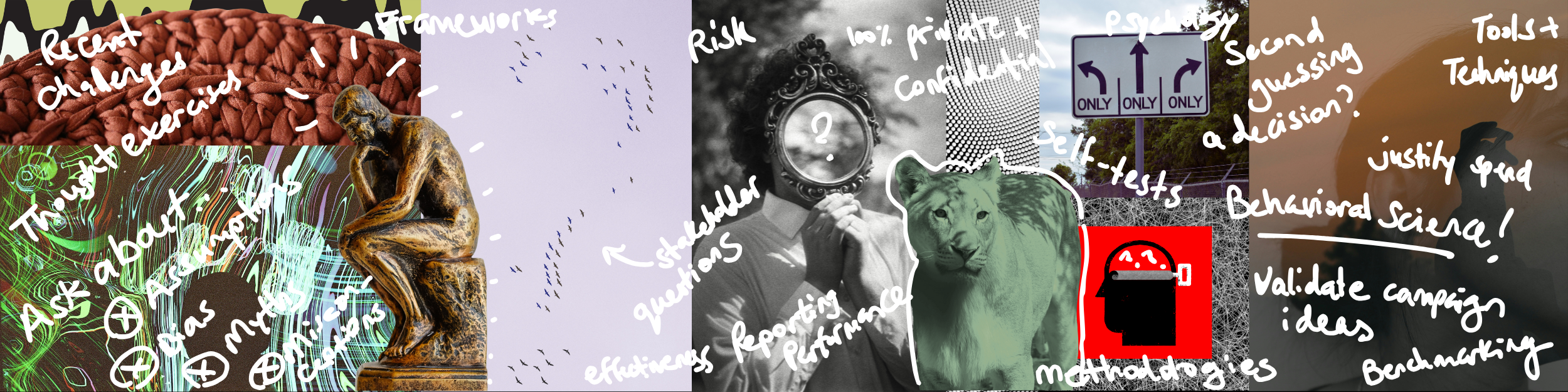
By providing a catalogue of multiple analytical lenses to look at their decision-making through, CCOs and their teams gain an enormous advantage that otherwise was unlikely due to a lack of centralization. Here are a few examples:
• The bias lens
• The stakeholder lens
• The counterfactual lens
• The scenario lens
• The evidence lens
• The comparison lens
CCOs—The output isn't a recommendation from us, it's a recommendation from you—stress-tested, assumption-documented, counter-arguments pre-addressed. You walk into the boardroom knowing your logic holds.
After spending the past seven years years in measurement & evaluation of communications, and working with some of the largest brands in the world—we observed the need for CCOs to elevate the critical thinking component of their role. Their drive to constantly evolve, adapt & learn, is what inspired our innovative approach to compliment their new capabilities in the AI-Age.
By providing multiple analytical lenses to look at their decision-making through, CCOs and their teams gain an enormous advantage that otherwise was unlikely due to a lack of centralization.
• The bias lens
• The stakeholder lens
• The counterfactual lens
• The scenario lens
• The evidence lens
• The comparison lens
CCOs—The output isn't a recommendation from us, it's a recommendation from you—stress-tested, assumption-documented, counter-arguments pre-addressed. You walk into the boardroom knowing your logic holds.

When we explore beneath the surface-level blockers to change—fear, self-doubt, and honest mistakes—we arrive at illusive cognitive gaps which can be explained using behavioral science (BehSci).
• Awareness of risks that others miss.
• Deeply nurture your professional skepticism.
• Call-out events using BehSci terms.
Pre-seeding Exercise ⟶ 20 minutes: Prompt your AI-copilot to explain these biases: ▫ Authority bias ▫ Confirmation bias ▫ Availability heuristic ▫ Groupthink ▫ Anchoring ▫ Recency effect ▫ Survivorship bias ▫ Framing effects ▫ Loss aversion ▫ Social proof.
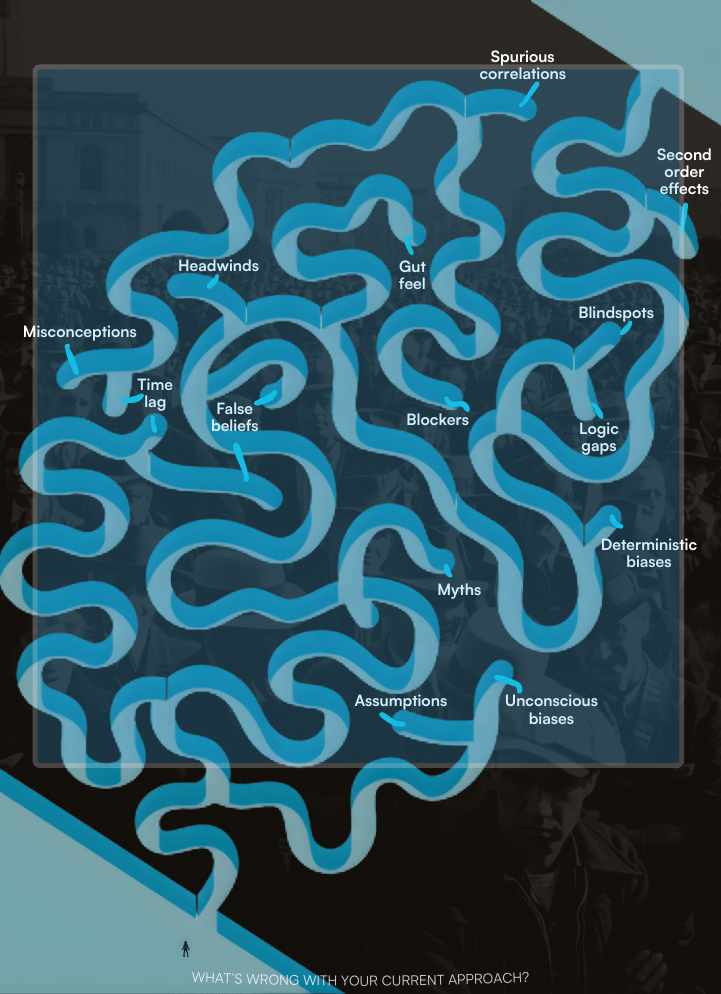
Whether it's in the form of an idea brought forth by a team member, or an initiative expressed by the executive committee—unconscious & structural biases permeate human thinking. Being aware of these biases, effects, fallacies & paradoxes enriches your team, and helps cut through noise to find vital signals.
BehSci explains forces that appear in communications planning, ideation, execution, and reporting—across all activities and outputs.
Part of our ethos is being epic. So we're going to reverse engineer the Top 5 desired impact we strive to have on your life as a communications leader.
**Please reach out to us after the session so we can high-five you when you experience any of the following changes:
• Better sleep during crisis periods because response patterns hold up
• Communication strategies that survive contact with reality, and thrive
• Promotions, recognition, confidence & trust both recieved and created
• Elevating the profile of PR & Comms within your organization


01
Time Pressure


02
Information Gaps


03
Competing Priorities
04
Context Changes


04
Context Shifts
05
Reputation Stakes


When was the last time you questioned whether a decision you were confident about might actually be wrong?
If you have a specific example in mind, can recall a moment of doubt, a post-mortem, or a time you changed course after reflection—that signals intellectual humility and openness to examining assumptions.
How do you currently defend your strategic recommendations when the CFO or CEO pushes back?
If you express a sense of frustration with the gap between correlation and causation in your evidence, mention wishing you had better frameworks, or that you rely on intuition more than you'd like—that signals awareness of the problem we can help you solve.
If we spent three hours stress-testing a real decision you're facing right now, what would you bring to the table?
If you immediately have something like a campaign launch, crisis scenario, a measurement challenge, or stakeholder conflict, and you find yourself leaning in a bit—that signals you have live challenges and want to work to solve them, not just learn theory.


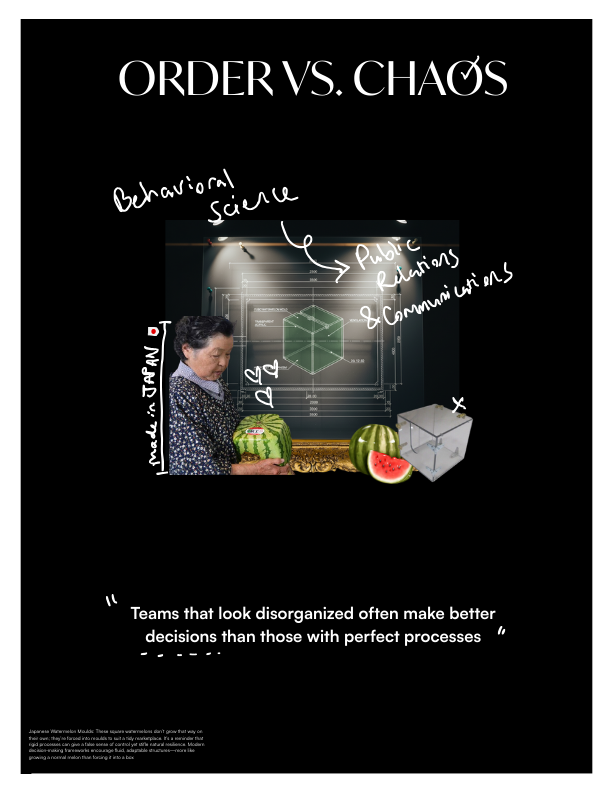
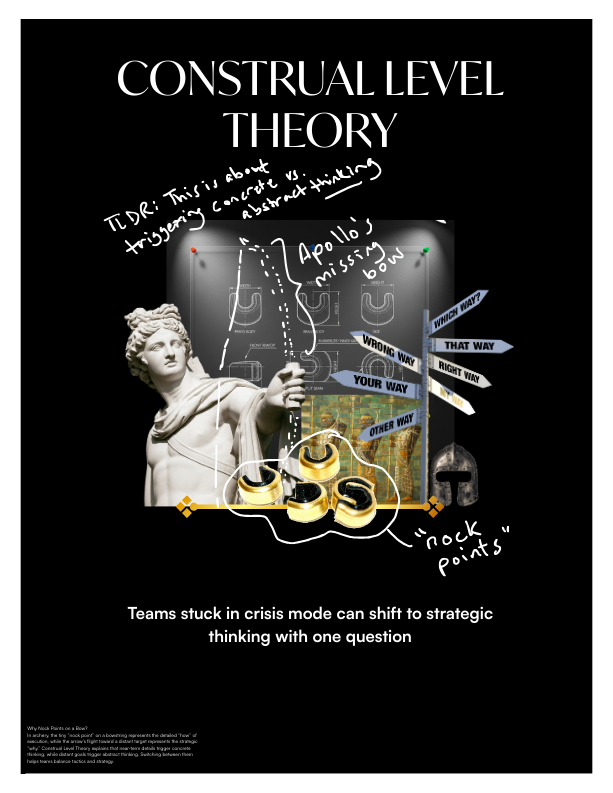
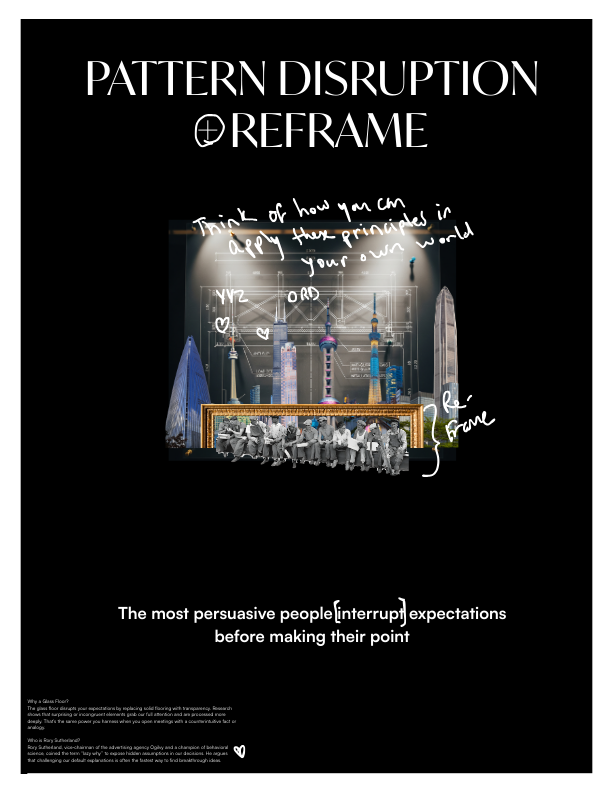
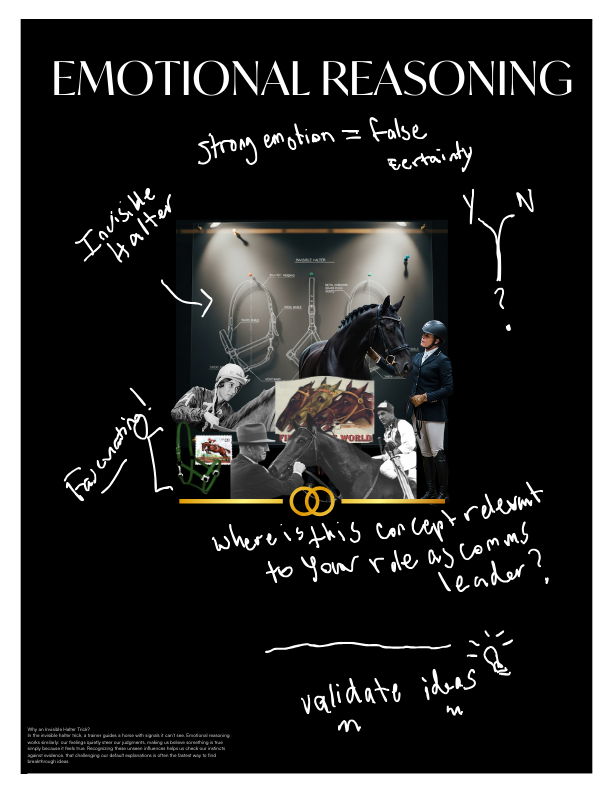
Behavioral science is one of several disciplines we draw from. These artifacts prime your team with its most practical concepts, so when we convene, the deeper work begins on common ground.




We work with a small number of senior communications leaders each quarter. If what you've read here resonates, this is where it starts.
